A Bundle is already in your cart
You can only have one active bundle against your account at one time.
If you wish to purchase a different bundle please remove the current bundle from your cart.
You have unused credits
You still have credits against a bundle for a different licence. Once all of your credits have been used you can purchase a newly licenced bundle.
If you wish to purchase a different bundle please use your existing credits or contact our support team.
02:11

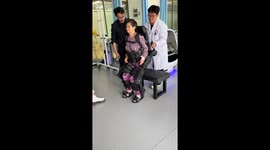
China: Breakthrough spinal interface helps paralyzed patient walk again

Storyline: A medical team at the Second Hospital of Jilin University in northeast China's Jilin Province has successfully helped a man who was completely paralyzed regain the ability to stand and walk through coordinated rehabilitation using a "spinal interface and exoskeleton robot" system. This breakthrough represents the world's first successful case where spinal interface technology has enabled a patient with complete high-level paralysis to regain voluntary movement, according to the hospital in Changchun City, capital of the province. Restoring voluntary movement in patients with high-level paralysis has long been a global medical challenge. Liu Boqi, 35, a traffic police officer from Fuyu City in Jilin Province, was severely injured in a car accident while on duty in December 2024. The crash caused a serious cervical spinal cord injury, leaving him completely paralyzed and breathing with difficulty. Wu Minfei, chief physician of the hospital's spine surgery department, performed an emergency surgery immediately after the accident. Although the operation saved Liu's life, it did not restore any movement in his limbs. Faced with this challenging situation, Wu's team decided to attempt an innovative approach that might give the patient a chance to regain voluntary control. According to Wu, in patients with severe cervical spinal injuries, the nerve connection between the brain and spinal cord is completely cut off. The technology involves implanting tiny microelectrodes at the injury point to stimulate and regulate the nerve cells responsible for limb movement, helping patients regain voluntary control over their paralyzed limbs. Encouraged by the initial progress, Wu's team continued two weeks of intensive nerve regulation therapy, during which Liu's muscle strength improved significantly. Three months later, doctors tailored a rehabilitation program that integrates the spinal interface with an exoskeleton robot. With the precise nerve signals from the spinal interface and physical support from the exoskeleton, Liu was able to take his first step since the accident. For Liu, the experience has been life-changing, and he is eager to see himself walk again. "It feels incredible to stand up and walk again. I'm full of hope for the future," said Liu. Shotlist: Changchun City, Jilin Province, northeast China - Recent: 1. Rehabilitation medicine center under Second Hospital of Jilin University 2. Various of Wu Minfei, chief physician, spine surgery department, Second Hospital of Jilin University, helping Liu Boqi, paralyzed patient, walk 3. Various of Liu's family member taking care of Liu 4. Various of Wu working with team member 5. SOUNDBITE (Chinese) Wu Minfei, chief physician, spine surgery department, Second Hospital of Jilin University (partially overlaid with shot 6): "We took a bold step by directly applying the spinal interface technology to the injured part of his spinal cord. While we had done some preliminary research before, this was the first time we used it in such a complex surgery." [SHOT OVERLAYING SOUNDBITE] 6. X-ray image [SHOT OVERLAYING SOUNDBITE] 7. Various of surgery in progress 8. Liu undergoing rehabilitation training 9. SOUNDBITE (Chinese) Wu Minfei, chief physician, spine surgery department, Second Hospital of Jilin University (partially overlaid with shot 10): "After we activated the spinal interface and started electrophysiological modulation, the patient's hand began to move. That moment was thrilling. It proved that the neural circuit from the brain to the spinal cord to the hand was reconnected." [SHOT OVERLAYING SOUNDBITE] 10. Various of Liu's family member taking care of Liu [SHOT OVERLAYING SOUNDBITE] 11. Various of Liu undergoing rehabilitation training 12. SOUNDBITE (Chinese) Zhang Haina, associate chief physician of rehabilitation medicine center, Second Hospital of Jilin University (ending with shot 13): "After the spinal interface surgery, we provided systematic rehabilitation including electrical stimulation, acupuncture, biofeedback, and manual therapy. His muscle strength, balance, and overall function have greatly improved. Now he can stand and walk with the help of the exoskeleton robot." 13. Various of Liu undergoing rehabilitation training 14. SOUNDBITE (Chinese) Liu Boqi, patient: "It feels incredible to stand up and walk again. I'm full of hope for the future." 15. Various of Liu practicing walking, accompanied by Wu [Restrictions : No access Chinese mainland]
Categories
From the blog
Stories not Stock: 3 Reasons Why You Should Use UGC Instead of Stock Video
Video content is an essential part of a brand’s marketing strategy, and while stock footage has been a reliable go-to in the past, forward-thinking companies are looking to user-generated content for their video needs.
View post