A Bundle is already in your cart
You can only have one active bundle against your account at one time.
If you wish to purchase a different bundle please remove the current bundle from your cart.
You have unused credits
You still have credits against a bundle for a different licence. Once all of your credits have been used you can purchase a newly licenced bundle.
If you wish to purchase a different bundle please use your existing credits or contact our support team.
01:44

Nicaragua: As U.S. boosts Caribbean military presence, critics in Latin America recall interventionist past

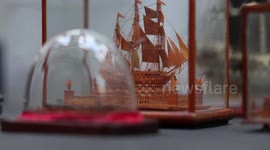
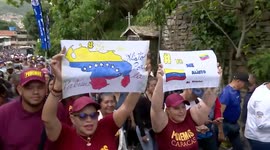
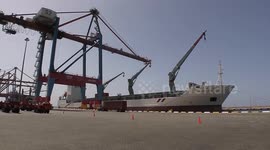
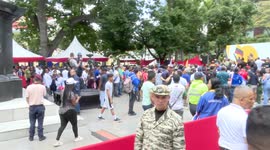
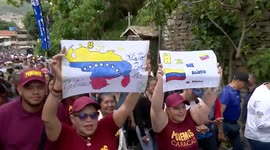
Shotlist FILE: Managua, Nicaragua - Dec 10, 2021 1. Various of traffic, national flag of Nicaragua Nicaragua - Recent 2. Various of sculptures, flags, flame at Revolution Square Masaya, Nicaragua - Recent 3. SOUNDBITE (Spanish) Janina Noguera, mayor of Masaya (partially overlaid with shot 4/ending with shot 5): "This heroic act took place on Feb. 26, 1978. A group of young people organized themselves to fight against the dictatorship of Anastasio Somoza. Unfortunately, their whereabouts were betrayed, and they were brutally massacred here by the National Guard. Right here at the Camilo Ortega Memorial Museum, we pay tribute to them every Feb. 26 for their significant contributions to Masaya and Nicaragua." [SHOT OVERLAYING SOUNDBITE] 4. Various of interior of memorial museum [SHOT OVERLAYING SOUNDBITE] 5. Various of portraits on wall, introduction boards on display 6. Various of pedestrians, portraits on wall Nicaragua - Recent 7. SOUNDBITE (Spanish) Wilfredo Navarro, Nicaraguan Congressman (ending with shot 8): "Nicaragua is located in the central part of the Americas, and has therefore long been considered a country that the United States must control. Furthermore, Nicaragua has a long history of resisting the will imposed by the United States, and the United States does not want to see any Latin American country 'rise up'." FILE: Managua, Nicaragua - Dec 10, 2021 8. Various of street views, traffic, people Storyline As the United States ramps up its military presence in the Caribbean, critics across Latin America are drawing renewed attention to a long and painful history of U.S. intervention in the region. In a recent interview with China Media Group (CMG), Nicaraguan political figures reflected on the country's history under U.S. influence, with a congressman saying Nicaragua has long resisted U.S. intervention and that Washington does not want to see Latin American nations rise up. Nicaragua was among the earliest and most persistent targets of U.S. political, economic, and military hegemony. From repeated military interventions in the early 20th century to covert operations in the 1980s, the Central American nation has repeatedly found itself in U.S. crosshairs. After direct military aggression against Nicaragua failed, the United States backed Anastasio Somoza, who had studied in the U.S. and long remained loyal to Washington, elevating him to head of the Nicaraguan army. In 1934, Somoza sent the national guard to assassinate Nicaraguan independence leader Augusto Cesar Sandino. He subsequently seized power in 1936 through manipulated elections, marking the beginning of the Somoza family's dictatorial rule over Nicaragua, which lasted for more than 40 years. The United States had provided substantial political, military, and economic support to the Somoza family, which was widely regarded as a pro-American proxy regime in Central America. In the struggle against the Somoza regime, numerous Nicaraguans sacrificed their lives. "This heroic act took place on Feb. 26, 1978. A group of young people organized themselves to fight against the dictatorship of Anastasio Somoza. Unfortunately, their whereabouts were betrayed, and they were brutally massacred here by the National Guard. Right here at the Camilo Ortega Memorial Museum, we pay tribute to them every Feb. 26 for their significant contributions to Masaya and Nicaragua," said Janina Noguera, mayor of Masaya. In July 1979, the Somoza family's dictatorship was overthrown; however, the United States continued to interfere in Nicaragua. Throughout the 1980s, the U.S. supported various anti-government armed groups, instigating a civil war that plunged Nicaragua back into turmoil. "Nicaragua is located in the central part of the Americas, and has therefore long been considered a country that the United States must control. Furthermore, Nicaragua has a long history of resisting the will imposed by the United States, and the United States does not want to see any Latin American country 'rise up'," said Wilfredo Navarro, a Nicaraguan congressman. [Restrictions: No access Chinese mainland]
Categories
From the blog
Stories not Stock: 3 Reasons Why You Should Use UGC Instead of Stock Video
Video content is an essential part of a brand’s marketing strategy, and while stock footage has been a reliable go-to in the past, forward-thinking companies are looking to user-generated content for their video needs.
View post