A Bundle is already in your cart
You can only have one active bundle against your account at one time.
If you wish to purchase a different bundle please remove the current bundle from your cart.
You have unused credits
You still have credits against a bundle for a different licence. Once all of your credits have been used you can purchase a newly licenced bundle.
If you wish to purchase a different bundle please use your existing credits or contact our support team.
01:33

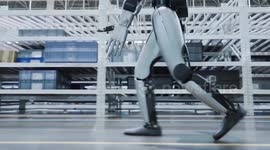
China: Humanoid robots featuring RL technology put into first industrial use in Shanghai

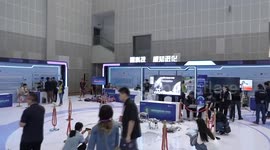
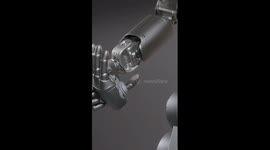
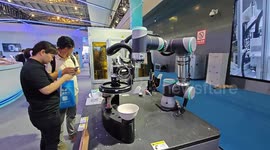
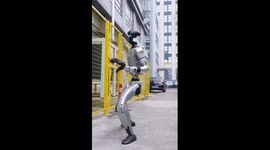
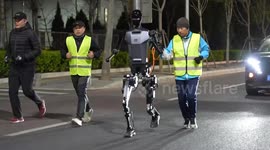
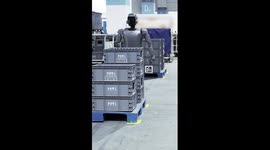
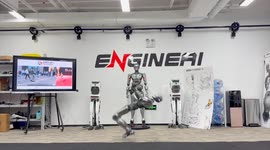
Storyline: Humanoid robots that feature embodied intelligence reinforcement learning (RL) technology were put into used on production lines at a factory in Shanghai on Monday, marking the world's first application of such robots in daily industrial scenarios. The robots, made by Shanghai-based robotics firm AgiBot, are equipped with the "Real-World Reinforcement Learning" technology, which can enable them to bypass lab training to learn directly on the factory floor. The technology has helped to significantly shorten the robot training period. A robot used to learn a new skill in weeks or even months at a training facility, but now it can master the skill in a dozen minutes on the job site. Furthermore, thanks to a high-precision coordination system, this humanoid robot also features excellent stability and a 100 percent task completion rate. "The tasks must be completed with millimeter-level precision and under very strict take time requirements. This demands that the robot's control units be designed to work in coordination. It's a systematic engineering effort, evolving the robot from merely repeating pre-set actions to being capable of autonomous learning and improvement," said Lou Jianlan, principal scientist at AgiBot. Beyond making robot learning faster, an end-to-end large model, developed by a Beijing-based robot company ROBOTERA, has enhanced robots' language systems. This large model allows robots to interpret instructions in real time at every step, eliminating their previous dependence on manual coding and significantly reducing time requirements. "Our language model has enabled robots to directly give a response and do some thinking. A new task can be directly deployed with no additional costs," said Chen Jianyu, founder of ROBOTERA. Improvements in robot performance require not only upgrades in software like intelligent systems but also corresponding advancements in mechanical hardware. Recently, the first dexterous hand powered by a large model entered mass production and application in China. Different from traditional dexterous hands, this model is equipped with high-resolution tactile sensors on each fingertip, capable of discerning forces as small as 0.05 newton. It can not only perform traditional precision assembly tasks but also handle many delicate everyday activities, such as petting a cat and using chopsticks to pick up tofu, adapting to various complex task scenarios. "Dexterous hands are key to the application and large-scale commercialization of humanoid robots. They can address 30 to 40 percent of non-standardized tasks that traditional grippers cannot cover. Service robots equipped with high-performance dexterous hands will become close partners that work and live with people," said Yu Ping, director of the AI Research Office at the Institute of Electronics of the China Center for Information Industry Development. Shotlist: FILE: China - Exact Location and Date Unknown: 1. Various of interior of smart product assembly workshop; robotic arms in operation 2. Various of humanoid robot working Shanghai, China - Recent: 3. Various of dexterous robot hand working 4. SOUNDBITE (Chinese) Lou Jianlan, principal scientist, AgiBot (starting with shots 2-3): "The tasks must be completed with millimeter-level precision and under very strict take time requirements. This demands that the robot's control units be designed to work in coordination. It's a systematic engineering effort, evolving the robot from merely repeating pre-set actions to being capable of autonomous learning and improvement." 5. Various of humanoid robot, visitors at exhibition 6. Robot handling parcels FILE: Wuxi City, Jiangsu Province, east China - Date Unknown: 7. Various of humanoid robot handling products on conveyor belt, walking Beijing, China - Recent: 8. SOUNDBITE (Chinese) Chen Jianyu, founder, ROBOTERA (ending with shot 9): "Our language model has enabled robots to directly give a response and do some thinking. A new task can be directly deployed with no additional costs." FILE: China - Exact Location and Date Unknown: 9. Various of humanoid robot working in car assembly plant FILE: Beijing, China - Date Unknown: 10. Various of fingers of dexterous robot hand moving under manual control; animation showing sensors on fingers, robot hands moving Beijing, China - Recent: 11. SOUNDBITE (Chinese) Yu Ping, director, AI Research Office, Institute of Electronics, China Center for Information Industry Development (starting with shot 10/ending with shot 12): "Dexterous hands are key to the application and large-scale commercialization of humanoid robots. They can address 30 to 40 percent of non-standardized tasks that traditional grippers cannot cover. Service robots equipped with high-performance dexterous hands will become close partners that work and live with people." FILE: Beijing, China - Date Unknown: 12. Various of dexterous robot hand working; humanoid robot petting cat FILE: Wuxi City, Jiangsu Province, east China - Date Unknown: 13. Various of humanoid robot dancing with elderly people 14. Various of humanoid robot dancing with visitors; visitor taking photo. [Restrictions: No access Chinese mainland]
Categories
From the blog
Stories not Stock: 3 Reasons Why You Should Use UGC Instead of Stock Video
Video content is an essential part of a brand’s marketing strategy, and while stock footage has been a reliable go-to in the past, forward-thinking companies are looking to user-generated content for their video needs.
View post