A Bundle is already in your cart
You can only have one active bundle against your account at one time.
If you wish to purchase a different bundle please remove the current bundle from your cart.
You have unused credits
You still have credits against a bundle for a different licence. Once all of your credits have been used you can purchase a newly licenced bundle.
If you wish to purchase a different bundle please use your existing credits or contact our support team.
02:56

China: STAR Market fuels China's aerospace innovation

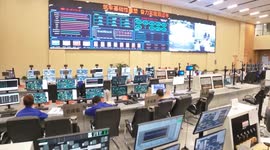
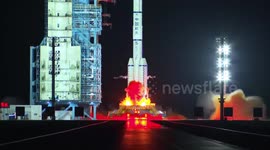
Shotlist Northwest China - Recent (CCTV - No access Chinese mainland) 1. Aerial shots of landing pad for China's independently developed Zhuque-3 reusable rocket 2. Various of Zhuque-3 rocket parts being transported 3. Various of Zhuque-3 rocket parts being assembled on launching pad Northwest China - Dec 3, 2025 (CCTV - No access Chinese mainland) 4. Various of Zhuque-3 rocket blasting off 5. Rocket separation in progress 6. Rocket recovery in progress Beijing, China - Recent (CCTV - No access Chinese mainland) 7. SOUNDBITE (Chinese) Dai Zheng, commander in chief, Zhuque-3 reusable rocket (partially overlaid with shots 8-9): "SpaceX’s latest valuation is now reportedly 400 billion U.S. dollars. The [U.S.] company can afford to develop massive launch vehicles like Starship, building multiple prototypes and flying them even when failure is likely. Each flight test uses over 30 first-stage engines, a scale that we are currently unable to match. SpaceX can push its products to the limit, even to the point of failure, to figure out the boundaries of the product and achieve rapid iteration. To some extent, I think our country has also recognized the necessity of such approach. It has allowed the STAR Market, for instance, to explicitly include commercial aerospace and embodied artificial intelligence among the innovation-driven sectors eligible for listing. By embedding these strategic directions into capital market rules, China is enabling enterprises like us to raise more funds, which is essential for competing with the world’s most advanced players." ++SHOTS OVERLAYING SOUNDBITE++ Northwest China - Recent (CCTV - No access Chinese mainland) 8. Various of Zhuque-3 rocket parts being transported Northwest China - Dec 3, 2025 (CCTV - No access Chinese mainland) 9. Various of Zhuque-3 rocket blasting off ++SHOTS OVERLAYING SOUNDBITE++ FILE: Shanghai, China - 2025 (CCTV - No access Chinese mainland) 10. Various of Shanghai Stock Exchange building, sign 11. Gong 12. Various of screens showing stock information Northwest China - Recent (CCTV - No access Chinese mainland) 13. Various of rocket crush site, debris, engineers working, having discussion Beijing, China - Recent (CCTV - No access Chinese mainland) 14. SOUNDBITE (Chinese) Dai Zheng, commander in chief, Zhuque-3 reusable rocket (starting with shot 13/partially overlaid with shots 15-17): "Only after experiencing failure can you gain the experience of trial and error, and only then can the company’s technological iteration truly go further. If you never take that first step, you will never acquire those lessons, and you won't be able to get any closer to success. From our engineering perspective, I believe that simply obtaining usable data is already a huge success. As for that final three kilometers, and the last critical brake, we’ll refine it next time and reach our goal." ++SHOTS OVERLAYING SOUNDBITE++ Northwest China - Recent (CCTV - No access Chinese mainland) 15. Rocket being transferred 16. Rocket on launch pad Northwest China - Dec 3, 2025 (CCTV - No access Chinese mainland) 17. Engineers in control center ++SHOTS OVERLAYING SOUNDBITE++ Northwest China - Recent (CCTV - No access Chinese mainland) 18. Various of rocket being assembled Storyline China's Nasdaq-style STAR Market is catalyzing breakthroughs in hard-tech sectors such as aerospace by supporting companies that push product boundaries through iterative testing, even at the risk of failure, said Dai Zheng, CEO of LandSpace, the developer of China's first reusable carrier rocket, Zhuque-3. On December 3, the reusable carrier rocket conducted its maiden flight. After ignition and liftoff, the first and second stages of the rocket separated in about 130 seconds. The second stage continued to complete the orbital insertion mission, while the first stage began its return journey. The reuse phase proceeded as scheduled, but the first-stage booster experienced anomalous combustion during recovery and failed to achieve a soft landing on the pad. The exact cause is under investigation. In an exclusive interview with China Central Television (CCTV) in Beijing, Dai, also the rocket's designer, said even SpaceX's flagship reusable launch vehicle, the Falcon 9, experienced numerous failures before its first successful landing. He also stressed that China's capital markets are now playing a crucial role in accelerating technological evolution in the sector. "SpaceX’s latest valuation is now reportedly 400 billion U.S. dollars. The [U.S.] company can afford to develop massive launch vehicles like Starship, building multiple prototypes and flying them even when failure is likely. Each flight test uses over 30 first-stage engines, a scale that we are currently unable to match. SpaceX can push its products to the limit, even to the point of failure, to figure out the boundaries of the product and achieve rapid iteration. To some extent, I think our country has also recognized the necessity of such approach. It has allowed the STAR Market, for instance, to explicitly include commercial aerospace and embodied artificial intelligence among the innovation-driven sectors eligible for listing. By embedding these strategic directions into capital market rules, China is enabling enterprises like us to raise more funds, which is essential for competing with the world’s most advanced players," said Dai. In June 2025, China's STAR Market introduced an updated policy expanding the scope of its fifth set of listing standards to include cutting-edge sectors such as artificial intelligence, commercial aerospace, and the low-altitude economy. The move opened financing channels for hard-tech companies that have yet to turn profitable. In parallel, China has accelerated its own satellite internet initiatives, intensifying the global race to deploy low-earth orbit constellations. Against this backdrop, the Zhuque-3 rocket achieved its maiden flight on December 3, 2025. While the first stage failed to achieve a soft landing on the recovery pad, the mission offers critical data for improving future iterations. "Only after experiencing failure can you gain the experience of trial and error, and only then can the company’s technological iteration truly go further. If you never take that first step, you will never acquire those lessons, and you won't be able to get any closer to success. From our engineering perspective, I believe that simply obtaining usable data is already a huge success. As for that final three kilometers, and the last critical brake, we’ll refine it next time and reach our goal," Dai stated.
Categories
From the blog
Stories not Stock: 3 Reasons Why You Should Use UGC Instead of Stock Video
Video content is an essential part of a brand’s marketing strategy, and while stock footage has been a reliable go-to in the past, forward-thinking companies are looking to user-generated content for their video needs.
View post