A Bundle is already in your cart
You can only have one active bundle against your account at one time.
If you wish to purchase a different bundle please remove the current bundle from your cart.
You have unused credits
You still have credits against a bundle for a different licence. Once all of your credits have been used you can purchase a newly licenced bundle.
If you wish to purchase a different bundle please use your existing credits or contact our support team.
01:34

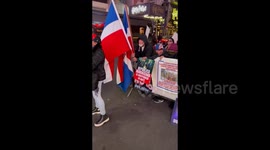
Dominican Republic: Dominicans criticize U.S. military actions for raising regional tensions

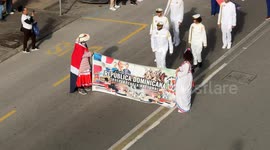
The latest U.S. military deployment in the Caribbean, including the Dominican Republic, is extensive in scale and has heightened regional sensitivities, according to Dominican experts and media outlets. The Dominican government recently made the decision to temporarily grant the U.S. access to an air force base and the country’s main international airport under the guise of "combating drug trafficking." This has led to the arrival of several U.S. military aircraft in the Dominican Republic, drawing widespread attention. In recent days, large U.S. military planes have landed at Dominican airports, including Las Américas International Airport in the capital Santo Domingo. Surrounding areas have seen fuel tanker trucks, buses, vans, light vehicles, communications equipment, and other military supplies, all under tight security measures. One of the country's leading newspapers, Diario Libre, reported that this move resembles a military deployment that goes far beyond mere anti-drug enforcement. The U.S. appears to be seeking to increase its military presence in the Caribbean while exerting pressure on Venezuela. Political figures in the country echoed similar sentiments. Dominican society, shaped by the historical memory of the 1965 U.S. military intervention, has reacted with unease to the current presence of U.S. troops. In April 1965, the U.S. sent more than 20,000 troops to the Dominican Republic during a civil war that followed the overthrow of democratically elected President Juan Bosch. In 1966, Bosch was decisively defeated by Dr. Joaquín Balaguer, a candidate favored by U.S. interests, who received 57 percent of the vote. He noted that his research has uncovered instances where the U.S. openly admitted to significant interference in Dominican elections and manipulation of political outcomes. Klinger also stressed that, for decades, U.S. influence has never left the Caribbean; rather, it has simply adopted different excuses over time. Shotlist: Santo Domingo, Dominican Republic - Recent: 1. Street, traffic; 2. SOUNDBITE (Spanish) Manuel Salazar, General Secretary, Communist Party of Labor in Dominican Republic (partially overlaid with shot 3): "[The Dominican government] carried out a severe crackdown on drug-related crimes, and this was done without U.S. military intervention. Therefore, the U.S.' so-called 'anti-drug' efforts are merely a pretext. The real objective is to implement its national security strategy, control the Caribbean, and threaten Venezuela." [SHOT OVERLAYING SOUNDBITE]; 3. Salazar speaking in interview [SHOT OVERLAYING SOUNDBITE]; 4. Street, traffic; 5. SOUNDBITE (Spanish) José Horacio Rodríguez, President, Democratic Choice: "The U.S. is seeking to expand its influence in the Caribbean, and the alleged 'combating drug trafficking' is simply an excuse."; FILE: Dominican Republic - April 2025 6. Various of cityscape, traffic, flag of Dominican Republic; Santo Domingo, Dominican Republic - Recent 7. Eduardo Klinger, member of Academy of Sciences of Dominican Republic, showing archive file; 8. SOUNDBITE (Spanish) Eduardo Klinger, member, Academy of Sciences of Dominican Republic: "The deployment of U.S. marines had a combat mission; they were opposing democratic forces in the Dominican Republic and supporting a dictatorial regime."; 9. Various of Klinger showing archive file; 10. SOUNDBITE (Spanish) Eduardo Klinger, member, Academy of Sciences of Dominican Republic: "In 1996, Arthur M. Schlesinger Jr., who served as an advisor to presidents Kennedy and Johnson, visited the Dominican Republic. During a press conference, he candidly confessed to participating in the electoral process to ensure Dr. Balaguer’s election."; FILE: Dominican Republic - April 2025 11. Aerial shot of cityscape. [Restrictions: No access Chinese mainland]
Categories
From the blog
Stories not Stock: 3 Reasons Why You Should Use UGC Instead of Stock Video
Video content is an essential part of a brand’s marketing strategy, and while stock footage has been a reliable go-to in the past, forward-thinking companies are looking to user-generated content for their video needs.
View post