A Bundle is already in your cart
You can only have one active bundle against your account at one time.
If you wish to purchase a different bundle please remove the current bundle from your cart.
You have unused credits
You still have credits against a bundle for a different licence. Once all of your credits have been used you can purchase a newly licenced bundle.
If you wish to purchase a different bundle please use your existing credits or contact our support team.
03:50

China: CGTN program exposes undeniable history of Yoshijiro Umezu’s war crimes in China

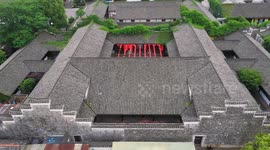
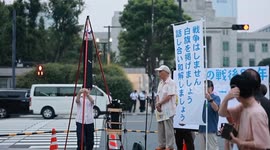
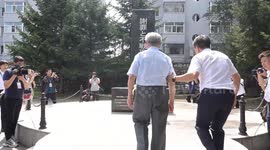
Beijing, China - Feb 26, 2014 (CCTV - No access Chinese mainland) 1. Various of visitors in museum 2. Photo showing signing ceremony between allied countries, Japan to announce Japan's unconditional surrender on September 2, 1945 3. Photo showing then Japanese Foreign Minister Mamoru Shigemitsu, then Chief of Japanese Army General Staff Yoshijiro Umezu at signing ceremony 4. Introduction of signing ceremony on September 2, 1945 5. Exhibited weapons used by Japanese troops in war Taipei City, Taiwan, China - Nov 30, 2013 (CCTV - No access Chinese mainland) 6. Photo showing Umezu signing Instrument of Surrender 7. Instrument of Surrender Harbin City, Heilongjiang Province, northeast China - Sept 15, 2023 (CCTV - No access Chinese mainland) 8. Aerial shots of Exhibition Hall of Evidence of Crime Committed by Unit 731 of Japanese Imperial Army FILE: Harbin City, Heilongjiang Province, northeast China - June 2, 2023 (CCTV - No access Chinese mainland) 9. Various of photos, documents on display Harbin City, Heilongjiang Province, northeast China - Date Unknown (CCTV - No access Chinese mainland) 10. Various of exhibits, statues Harbin City, Heilongjiang Province, northeast China - Aug 15, 2025 (CGTN - No access Chinese mainland) 11. SOUNDBITE (Chinese) Jin Chengmin, director, Exhibition Hall of Crime Evidence of Japanese Army Unit 731 (ending with shot 12): "The Japanese biological warfare units expanded with the direct involvement of the Japanese government, the military high command, the Kwantung Army, and the medical community. This fully demonstrates that Japan's biological warfare was a premeditated, organized, and state-led crime, carried out from the top down." Harbin City, Heilongjiang Province, northeast China - Date Unknown (CCTV - No access Chinese mainland) 12. Various of photos, documents on display Tokyo, Japan - Aug 15, 2014 (CCTV - No access Chinese mainland) 13. Various of Yasukuni Shrine 14. Various of Japanese public at anti-Yasukuni Shrine protest Tokyo, Japan - Aug 15, 2025 (CCTV - No access Chinese mainland) 15. Various of protesters marching through street, police officers, banner reading "Oppose Yasukuni Shrine" 16. Various of protesters marching through street, holding banners Beijing, China - Dec 19, 2025 (CCTV - No access Chinese mainland) 17. SOUNDBITE (Chinese) Guo Jiakun, spokesman, Ministry of Foreign Affairs: "History and reality have proven that returning to militarism is a path of evil, and a path that inevitably leads to a dead end. Making a clean break with militarism and sincerely pursuing the path of peaceful development is a crucial prerequisite for Japan to gain the trust and understanding of the international community, especially its Asian neighbors. It is also the right choice that aligns with the fundamental interests of the Japanese people." Harbin City, Heilongjiang Province, northeast China - Sept 17, 2021 (CCTV - No access Chinese mainland) 18. Aerial shots of former site of Unit 731 19. Aerial shots of boilers built by Unit 731 Beijing, China - Oct 30, 2023 (CCTV - No access Chinese mainland) 20. Entrance to "Museum of the War of Chinese People's Resistance Against Japanese Aggression" Nanjing City, Jiangsu Province, east China - Dec 13, 2025 (CCTV - No access Chinese mainland) 21. Soldiers carrying wreaths, marching 22. Memorial ceremony for victims of Nanjing Massacre in progress Storyline A program produced by China Global Television Network (CGTN) aired on Saturday presented the unerasable evidence of crimes committed by Yoshijiro Umezu, a top leader in Japan's wartime military during the invasion of China, exposing the history that must never be forgotten. Umezu was a notorious name deeply involved in Japan's war of aggression against China. As Chief of the Army General Staff, he was closely linked to atrocities like the brutal policy of "Three Alls" - kill all, burn all, and loot all - and the inhuman experiments of Unit 731. Umezu was dispatched to China in March 1934. His role spanned the entire course of Japan's aggression, from the invasion of northeast China to the collapse of the Pacific War. In May 1935, Umezu presented then-acting chairman of the Beiping Military Council, He Yingqin, with an outrageous demand to expel Chinese forces from North China. He then redeployed Japanese troops south from northeast China, coercing He into signing the He–Umezu Agreement, effectively opening the door for Japan's full-scale military expansion into North China. In 1938, Umezu became commander of the Japanese First Army. He enforced the savage "Three Alls" policy, inflicting immense suffering on the Chinese people. Statistics show that during the Chinese People's War of Resistance against Japanese Aggression, as many as 7 million civilians in North China were killed under the "Three Alls" policy. Umezu became known among the Chinese as the "Demon of the Three Alls." One of the most heinous units Japan deployed in China was Unit 731. When it was first established, the unit had no official designation. It was Umezu, then commander of the Kwantung Army, who granted it its code number and helped expand its operations. That's why he is widely regarded as the man behind Unit 731. At least tens of thousands of Chinese, Soviet and Korean civilians, and Allied prisoners of war were used as live subjects in human experiments, dying in extreme pain and cruelty. This chapter of history remains an indelible scar on the conscience of human civilization. "The Japanese biological warfare units expanded with the direct involvement of the Japanese government, the military high command, the Kwantung Army, and the medical community. This fully demonstrates that Japan's biological warfare was a premeditated, organized, and state-led crime, carried out from the top down," said Jin Chengmin, director of the Exhibition Hall of Crime Evidence of Japanese Army Unit 731. As a loyal executor of Japan's expansionist militarist strategy, Umezu did not limit his crimes to China. In 1941, having previously taken part in the Russo-Japanese War, Umezu organized large-scale military exercises targeting the Soviet Union as a hypothetical enemy. He continued to train Kwantung Army forces and sent large numbers of elite troops to the Pacific Theater. On the morning of September 2, 1945, the ceremony formally marking Japan's unconditional surrender was held on the deck of the USS Missouri. After the ceremony and the final victory in the world's anti-fascist war, Umezu was put on trial at the Tokyo Tribunal, among the highest-ranking military officers. He was convicted as a Class-A war criminal and sentenced to life imprisonment in November 1948. Although he escaped execution, justice was not denied forever. On January 8, 1949, Umezu died of rectal cancer in Sugamo Prison in Tokyo without ever admitting guilt. After his death, Umezu's spirit tablet was enshrined at Yasukuni Shrine, alongside 14 Class-A war criminals. For years, despite strong opposition from Asian countries and criticism from the international community, some Japanese right-wing politicians have repeatedly visited the shrine. This is far more than a so-called act of mourning. It is a blatant challenge to historical verdicts, a deep insult to the victims of aggression, and a dangerous attempt to rehabilitate militarist crimes. "History and reality both prove that returning to militarism is a dead end. Completely breaking with militarism and sincerely pursuing peaceful development is a crucial precondition for Japan to gain the trust and understanding of the international community, especially its Asian neighbors, and is also the correct choice in the interests of the Japanese people," Chinese Foreign Ministry Spokesman Guo Jiakun said at a recent press briefing in Beijing.
Categories
From the blog
Stories not Stock: 3 Reasons Why You Should Use UGC Instead of Stock Video
Video content is an essential part of a brand’s marketing strategy, and while stock footage has been a reliable go-to in the past, forward-thinking companies are looking to user-generated content for their video needs.
View post