A Bundle is already in your cart
You can only have one active bundle against your account at one time.
If you wish to purchase a different bundle please remove the current bundle from your cart.
You have unused credits
You still have credits against a bundle for a different licence. Once all of your credits have been used you can purchase a newly licenced bundle.
If you wish to purchase a different bundle please use your existing credits or contact our support team.
02:10

China: China-France education collaboration delivers new success in research, talent development

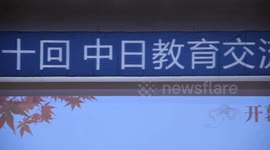
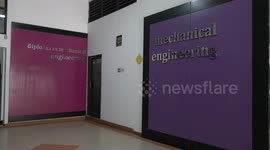
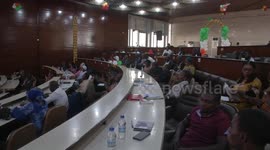
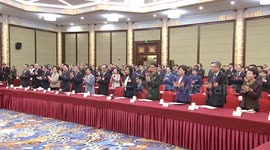
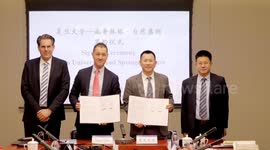
China-France educational cooperation has delivered fresh progress over the past year, with notable achievements in talent cultivation and joint scientific research. At Beihang University, Centrale Pekin, or the Sino-French engineering school, established two decades ago -- inaugurated a joint carbon-neutrality laboratory last year and received its first cohort of French students this year. For Eva, a French graduate student, this marks her second academic journey to China. I think the education here of engineering is really good. Here, the Sino-French engineering school is like the same as the French teaching because it's a partnership between Beihang and a French school, (so it includes instruction from) French teachers who are coming here to teach. A lot of Chinese professors have some specific topic of research. So here, all during the three years of master, every year we have classes and we also have some practice of three months of internship and six months of internship to do in companies. So, we have a whole package together," she said. Over the past year, Chinese and French universities have jointly launched more than 20 dual-degree programs, facilitating faculty and student exchanges, curriculum integration, and credit recognition. The total number of cooperative educational institutions and programs between the two sides has reached 72. Over the past year, Chinese and French universities have established 10 new joint laboratories and advanced over 90 research collaborations. At Xiamen University, the Ocean Negative Carbon Emissions international project initiated by Chinese scientists with deep involvement from French research institutions, has achieved new progress. The pilot-scale project to alkalize wastewater to increase carbon sink, synchronously deployed in China and France, has yielded preliminary results, increasing marine carbon sinks by three to five tonnes for each 10,000 tonnes of treated wastewater. At China University of Geosciences (Beijing), a Chinese team collaborated with France's Institute for Research in Astrophysics and Planetology to analyze radon gas data collected in situ by Chang'e-6 during humanity's first sampling mission on the Moon's far side. By integrating remote sensing imagery, they preliminarily identified potential release pathways and distribution patterns of radon gas on the far side, opening a new chapter in lunar in-situ exploration. Shotlist: Beijing, China - Recent: 1. Building on campus; 2. Sign reading (Chinese): "Sino-French Engineer School"; 3. Gate of lab, students; 4. Sign reading (Chinese/English): "Beihang-Centrale group joint lab on Carbon neutralization"; 5. Various of class in progress; 6. SOUNDBITE (English) Eva, French graduate student (starting with shot 5/partially overlaid with shot 7): "I think the education here of engineering is really good. Here, the Sino-French engineering school is like the same as the French teaching because it's a partnership between Beihang and a French school, (so it includes instruction from) French teachers who are coming here to teach. A lot of Chinese professors have some specific topic of research. So here, all during the three years of master, every year we have classes and we also have some practice of three months of internship and six months of internship to do in companies. So, we have a whole package together." [SHOT OVERLAYING SOUNDBITE]; 7. Various of class in progress, Chinese, French students doing experiment, research together [SHOT OVERLAYING SOUNDBITE]; 8. Aerial shot of campus; 9. Sign reading (Chinese/French): "Sino-French Engineer School of Beihang University"; 10. Various of Chinese, French students doing experiment together; 11. Building on campus; Chengdu City, Sichuan Province, southwest China - Recent 12. SOUNDBITE (Chinese) Dong Zhuoning, dean, Hangzhou International Innovation Institute, Beihang University (starting with shot 11/partially overlaid with shots 13-14): "Beihang operates three China-France cooperative institutions in Beijing and Hangzhou, admitting approximately 500 undergraduates annually. Students can earn dual degrees and diplomas from both China and France. Moving forward, we will leverage Hangzhou and the Yangtze River Delta region's industrial strengths to focus on interdisciplinary research in fields such as artificial intelligence, biomedicine, and carbon neutrality." [SHOTS OVERLAYING SOUNDBITE]; Beijing, China - Recent 13. Various of Chinese, French students doing experiment together; 14. Various of drones [SHOTS OVERLAYING SOUNDBITE]; 15. Various of class in progress; Xiamen City, Fujian Province, east China - Recent 16. Aerial shot of city view; 17. Sign reading (English/Chinese): "Sino-French Joint Laboratory for Ocean Research and Education (LORE)"; 18. Professor talking to students; 19. Sign for Ocean Negative Carbon Emissions (ONCE) program; 20. Various of researchers working on river; 21. Treated water flowing into river; 22. Aerial shot of city view, river; Beijing, China - Recent 23. Logo of China University of Geosciences; 24. Sign of branch of research center for Lunar and Planetary exploration; 25. Various of teacher talking to students; 26. Various of computer screen showing data, images. [Restrictions: No access Chinese mainland]
Categories
From the blog
Stories not Stock: 3 Reasons Why You Should Use UGC Instead of Stock Video
Video content is an essential part of a brand’s marketing strategy, and while stock footage has been a reliable go-to in the past, forward-thinking companies are looking to user-generated content for their video needs.
View post