A Bundle is already in your cart
You can only have one active bundle against your account at one time.
If you wish to purchase a different bundle please remove the current bundle from your cart.
You have unused credits
You still have credits against a bundle for a different licence. Once all of your credits have been used you can purchase a newly licenced bundle.
If you wish to purchase a different bundle please use your existing credits or contact our support team.
02:03

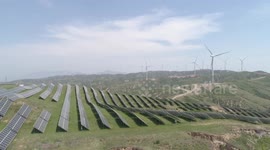
China: Urumqi-Yuli Expressway merges ecological conservation into green infrastructure

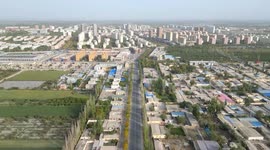
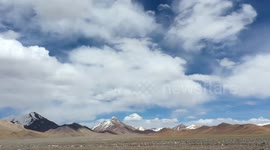
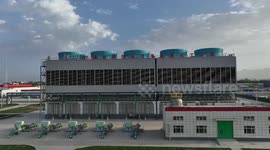
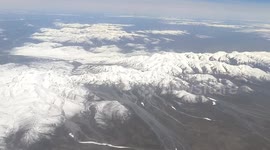
Shotlist Xinjiang Uygur Autonomous Region, northwest China - Dec 25, 2025 (CCTV - No access Chinese mainland) 1. Various of sheep foraging, passing through culvert 2. Aerial shots of Urumqi-Yuli Expressway 3. Various of mobile phone screen showing footage of little fox 4. SOUNDBITE (Chinese) Lu Zejian, Party branch secretary, No.5 construction segment, Xinjiang Urumqi-Yuli Expressway Project, China Communications Construction Company Limited (starting with shot 3/ending with shot 5): "Look at this little fox, we took a video of it. I interacted and played with it for a while. Then one day, the fox came into my office, wandering around, and then left. It wasn't afraid of me anymore." FILE: Xinjiang Uygur Autonomous Region, northwest China - Date Unknown (CCTV - No access Chinese mainland) 5. Little fox in office Xinjiang Uygur Autonomous Region, northwest China - Dec 25, 2025 (CCTV - No access Chinese mainland) 6. Aerial shots of Urumqi-Yuli Expressway, signs, snow-covered mountains 7. SOUNDBITE (Chinese) Lu Zejian, Party branch secretary, No.5 construction segment, Xinjiang Urumqi-Yuli Expressway Project, China Communications Construction Company Limited (ending with shot 8): "During construction, we built three sewage treatment plants with a combined capacity of 17,500 cubic meters per day, capable of treating water to the standard of secondary surface water quality." 8. Aerial shots of sewage treatment plant 9. Various of Urumqi-Yuli Expressway, Suaeda glauca on roadside 10. SOUNDBITE (Chinese) Zhu Genshen, chief engineer, No.1 construction segment, Xinjiang Urumqi-Yuli Expressway Project, China Communications Construction Company Limited (starting with shot 9/ending with shot 11): "These are the Suaeda glauca we planted in May this year. By next spring, this area will be lush and green again. We hope our project becomes part of the local beautiful landscape." 11. Aerial shots of Urumqi-Yuli Expressway, snow-covered mountains Storyline The Urumqi-Yuli Expressway that traverses the Tianshan Mountains in northwest China's Xinjiang Uygur Autonomous Region exemplifies the integration of ecological conservation and infrastructure development in areas marked by fragile and complex ecosystems. After over five years of construction, the expressway opened to traffic on Friday. Stretching 2,500 kilometers, the Tianshan Mountains span central Xinjiang, separating Urumqi, the largest city in the north, from Korla, the largest city in the south. With the opening of the expressway, travel time between these two cities is reduced from seven hours to about three hours, promoting economic integration between northern and southern Xinjiang and creating new channels for external exchanges. As the road traverses through multiple pastoral areas, initial concerns among herders centered on its potential to damage grazing lands and disrupt livestock movement. Innovative ecological measures, such as corridors for animals, have alleviated these worries. Now, with specially designed culverts, sheep and cattle can cross safely underneath the expressway. The route also passes through several forest parks under the protection at the national-level or autonomous regional level, which are habitats for endangered species including snow leopards and ibex goats. In a 116-kilometer ecologically sensitive section, constructors have built numerous tunnels and over 30 bridges, with nearly 60 percent of the route crossing mountain ridges via bridges and tunnels, aiming to minimize habitat fragmentation and maintain animal migration pathways. Lu Zejian, Party branch secretary of the No.5 construction segment of the expressway project, shared his experience of interacting with a little fox. "Look at this little fox, we took a video of it. I interacted and played with it for a while. Then one day, the fox came into my office, wandering around, and then left. It wasn't afraid of me anymore," said Lu. As a key project of the expressway and the world's longest expressway tunnel, the 22.13-km Tianshan Shengli Tunnel officially opened to traffic on the same day. Over 10 kilometers upwards from the entrance of the tunnel lies the Glacier No. 1 in the Tianshan Mountains, where the meltwater from the glacier converges into the mother river of Urumqi. Protecting these water sources from being polluted was a critical concern during the construction of the project. "During construction, we built three sewage treatment plants with a combined capacity of 17,500 cubic meters per day, capable of treating water to the standard of secondary surface water quality," said Lu. The expressway now serves as a vital ecological and economic artery, linking the northern and southern regions of Tianshan Mountains while supporting local biodiversity. Animals freely move along ecological corridors, and native plants are steadily thriving along the roadside. "These are the Suaeda glauca we planted in May this year. By next spring, this area will be lush and green again. We hope our project becomes part of the local beautiful landscape," said Zhu Genshen, chief engineer of the project's No.1 construction segment.
Categories
From the blog
Stories not Stock: 3 Reasons Why You Should Use UGC Instead of Stock Video
Video content is an essential part of a brand’s marketing strategy, and while stock footage has been a reliable go-to in the past, forward-thinking companies are looking to user-generated content for their video needs.
View post