A Bundle is already in your cart
You can only have one active bundle against your account at one time.
If you wish to purchase a different bundle please remove the current bundle from your cart.
You have unused credits
You still have credits against a bundle for a different licence. Once all of your credits have been used you can purchase a newly licenced bundle.
If you wish to purchase a different bundle please use your existing credits or contact our support team.
01:25

China: Tarim Oilfield's annual green electricity output tops 2 billion kWh

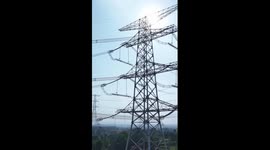
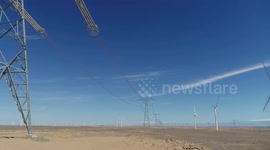
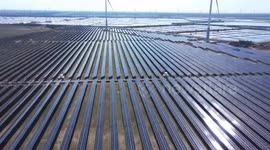
Shotlist FILE: Xinjiang Uygur Autonomous Region, northwest China - Date Unknown 1. Aerial shots of photovoltaic power station; solar panels Xinjiang Uygur Autonomous Region, northwest China - Recent 2. SOUNDBITE (Chinese) Liang Yulei, manager, new energy department, Tarim Oilfield, CNPC (starting with shot 1/ending with shots 3-4): "Our annual solar power output has achieved leapfrog growth over the past three years, from 260 million kWh in 2023 to 1.34 billion kWh in 2024, and now exceeding 2 billion kWh this year. This marks a leap forward from scratch to a considerable scale." 3. Various of workers at office; screen showing data FILE: Xinjiang Uygur Autonomous Region, northwest China - Date Unknown 4. Aerial shot of solar panels 5. Various of bulldozers; bulldozer working 6. Aerial shots of bulldozers working 7. Aerial shots of solar panels Xinjiang Uygur Autonomous Region, northwest China - Recent 8. SOUNDBITE (Chinese) Lei Ting, executive director, new energy department, Tarim Oilfield, CNPC (ending with shots 9-12): "By installing photovoltaic panels over shifting sands, we generate power above while lowering wind speed and creating shade below. Under the panels, we have laid drip irrigation belts for biological sand control, achieving multiple benefits at one go. Our total installed capacity is expected to exceed 4 GW next year." FILE: Xinjiang Uygur Autonomous Region, northwest China - Date Unknown 9. Aerial shots of shrubs, solar panels; solar panels 10. Various of workers checking pipelines 11. Aerial shot of solar panels 12. Various of workers at work 13. Aerial shots of facilities 14. Aerial shots of high-voltage power transmission lines Storyline The Tarim Oilfield in northwest China's Xinjiang Uygur Autonomous Region has generated over 2 billion kilowatt-hours (kWh) of solar power this year, setting a new annual record, China National Petroleum Corporation (CNPC) announced on Sunday. According to CNPC, the Tarim oilfield, as a major source for China's west-to-east gas transmission project, also set a historic single-day high of over 10 million kWh in solar generation, marking a new integrated development pattern for oil, gas, and new energy in the heart of the Taklamakan Desert. "Our annual solar power output has achieved leapfrog growth over the past three years, from 260 million kWh in 2023 to 1.34 billion kWh in 2024, and now exceeding 2 billion kWh this year. This marks a leap forward from scratch to a considerable scale," said Liang Yulei, manager of the new energy department of the Tarim Oilfield, CNPC. Across oil and gas well sites deep in the Taklamakan Desert in the Tarim Basin, 239 distributed solar projects have been installed, covering approximately 6,667 hectares of desert land -- an effort that aligns energy development with ecological protection. To date, the Tarim oilfield has built five large-scale photovoltaic power stations in Yuli, Qiemo, Yecheng and Jiashi Counties, as well as Shangku high-tech industrial development zone, with a total installed capacity of 2.6 gigawatts (GW). "By installing photovoltaic panels over shifting sands, we generate power above while lowering wind speed and creating shade below. Under the panels, we have laid drip irrigation belts for biological sand control, achieving multiple benefits at one go. Our total installed capacity is expected to exceed 4 GW next year," said Lei Ting, executive director of the new energy department of the Tarim Oilfield. Construction is now fully underway on a new 100-megawatt solar project in Xinjiang’s Luntai County, on the northern brim of the Taklamakan Desert. Once operational, it will generate 158 million kWh of green electricity annually. Of the green power generated in the desert, 8 percent will be used for local oil and gas production, while the remaining 92 percent will be transmitted outside Xinjiang, helping cut the oilfield's energy use and carbon emission intensity by over 10 percent, while also supplying green electricity to households across China. [Restrictions: No access Chinese mainland]
Categories
From the blog
Stories not Stock: 3 Reasons Why You Should Use UGC Instead of Stock Video
Video content is an essential part of a brand’s marketing strategy, and while stock footage has been a reliable go-to in the past, forward-thinking companies are looking to user-generated content for their video needs.
View post