A Bundle is already in your cart
You can only have one active bundle against your account at one time.
If you wish to purchase a different bundle please remove the current bundle from your cart.
You have unused credits
You still have credits against a bundle for a different licence. Once all of your credits have been used you can purchase a newly licenced bundle.
If you wish to purchase a different bundle please use your existing credits or contact our support team.
Appears in Newsflare picks
08:07

Gaza's gravedigger of 18,000: A father's testimony of loss, unending burials under Israeli attacks

SHOTLIST
KHAN YOUNIS, GAZA STRIP, PALESTINE (DEC. 18, 2025) (ANADOLU-ACCESS ALL)
1. VARIOUS OF TURKISH CEMETERY WITH NEWLY DUG GRAVES, PEOPLE AND GRAVE DIGGERS
2. CLOSE-UP OF YOUSEF ABU HATAB’S SHOVEL DIGGING SOIL
3. YOUNG MAN AND YOUSEF ABU HATAB DIGGING GRAVE
4. GRAVE DIGGERS TANDING IN DUG HOLE
5. GRAVES
6. ABU HATAB STANDING, LOOKING AT GRAVE DIGGERS
7. CLOSE-UP OF BOY SITTING AT CEMETERY
8. ABU HATAB STANDING, LOOKING AT GRAVE DIGGERS (2 SHOTS)
9. CLOSE-UP OF BOY SITTING AT CEMETERY
10. BRICKS IN OPEN GRAVE, ABU HATAB SITTING ON BRICKS NEXT TO GRAVE
11. ABU HATAB WALKING, CARRYING SHOVEL ON HIS SHOULDER
12. ABU HATAB SITTING WHEELBARROW
13. (SOUNDBITE) (Arabic) PALESTINIAN GRAVEDIGGER, YOUSEF ABU HATAB, SAYING:
“This is the most difficult period I have ever experienced in burial work, in labor, in hardship, and in exhaustion. I have never seen fatigue like this before. From October 15, 2023 until today, during this period, I have buried approximately 17,000 to 18,000 martyrs.”
14. YOUNG MAN DIGGING GRAVE
15. TIGHT SHOT OF ABU HATAB SITTING
16. CLOSE-UP OF ABU HATAB
17. (SOUNDBITE) (Arabic) PALESTINIAN GRAVEDIGGER, YOUSEF ABU HATAB, SAYING:
“Amid massacres, amid rubble, amid mass graves, amid horrific scenes — scenes where about 15 bodies were placed in one underground room and sealed inside. These became collective graves. Near Nasser Hospital in Khan Younis, mass burial operations took place. When we later entered the area around Nasser Hospital, which is a medical center, we found that 550 bodies had been buried there. Israeli occupation forces entered while I was sitting in the washing facility office. I was there, watching them with my own eyes. I am the shrouder. I am the one who washes the bodies. I am the one who buries them.”
18. CLOSE-UP OF MAN MEASURING STONE
19. (SOUNDBITE) (Arabic) PALESTINIAN GRAVEDIGGER, YOUSEF ABU HATAB, SAYING:
“I am still continuing this work up to this moment. In a single week, I would not say fewer than 50 or 60 people. There were days when I buried 50, 60, 70, 80, even 100 bodies. We would move them directly from the shrouding area to the graves, to mass graves, because there was no space available for us.”
20. WHITE FLASH
21. (SOUNDBITE) (Arabic) PALESTINIAN GRAVEDIGGER, YOUSEF ABU HATAB, SAYING:
“Throughout all this time, I am doing what I can, honestly. How can I even describe it to you? How can I describe seeing a son gone, another gone, bodies torn apart, limbs severed from human beings — people who were living normal lives, people who had hopes. Some were young, some were elderly, 60 or 65 years old.”
22. WHITE FLASH
23. (SOUNDBITE) (Arabic) PALESTINIAN GRAVEDIGGER, YOUSEF ABU HATAB, SAYING:
“This period affected me deeply. I became withdrawn and no longer liked to mix with people. People started saying that I had become addicted to being around the graves, that I was trapped in this graveyard life.”
24. WHITE FLASH
25. (SOUNDBITE) (Arabic) PALESTINIAN GRAVEDIGGER, YOUSEF ABU HATAB, SAYING:
“There was a concrete structure where four children had been buried. I was dealing with a grave on my own. They were bombed — three people were killed. Two months later, the police brought a bag containing unidentified remains: hands, legs, heads, body parts stuck together from here and there. They told us, ‘You are the one who can recognise things — see if you can identify them.’ They brought the bag to this grave where the girl was buried. I opened it and placed the bag inside.I swear, I could not stay inside that grave for more than one minute. I went in, put it down, closed it, and came back out — one minute. The girl stayed inside the grave for an hour.They asked me, ‘What’s wrong with you? What happened to you inside?’ I told them, ‘Come and smell it. Smell this odor. Smell the stench — something you will never forget.’”
26. WHITE FLASH
27. (SOUNDBITE) (Arabic) PALESTINIAN GRAVEDIGGER, YOUSEF ABU HATAB, SAYING:
“They brought me heavy equipment and told me, ‘Let’s work.’ They said, ‘Bring cement, bring gravel, bring stone. Bring cloth — cloth, cloth.’This is the washing place. Bring this, bring that. Bring perfume, perfume for the dead. I don’t have soap to wash the dead. I don’t have anything. For Allah’s sake, for Allah’s sake, bring soap — soap. Everything has collapsed. By Allah, everything has fallen. I don’t have water. I don’t have water.”
28. YOUSEF ABU HATAB SHOWING GRAVEYARD, STANDING NEAR GRAVEDIGGERS AS HE SAYS “All of this is destiny. We endure it, and we get tired — everyone feels this exhaustion. We are worn out, completely drained, physically and emotionally.”
29. ABU HATAB WALKING AND SPEAKING AS YOUNG MAN PUSHES
WHEELBARROW FILLED WITH SOIL / YOUNG MAN UNLOADING WHEELBARROW
30. ABU HATAB GIVING INSTRUCTIONS TO YOUNG GRAVE DIGGERS AS THEY CARRY BRICKS
31. YOUNG GRAVE DIGGER PLACING BRICKS ON OTHERS ON SOIL
32. WOMAN BEHIND WIRE FENCE NEAR CEMETERY, WALKING AWAY CARRYING BUCKET
33. VARIOUS OF ABU HATAB WALKING AROUND IN CEMETERY AS OTHERS WORK
34. ABU HATAB AND YOUNG MAN DIGGING GRAVE, POURING SOIL INTO WHEEL BARROW
35. ABU HATAB SITTING ON BRICKS, WATCHING GRAVEDIGGER (2 SHOTS)
36. ABU HATAB SHOVELING SOIL
37. VARIOUS OF PEOPLE WALKING IN CEMETERY
38. CLOSE-UP OF DUG GRAVE BEING MEASURED BY DIGGER
39. GRAVE DIGGER UNLOADING WHEELBARROW, POURING SOIL ON GROUND
40. DIGGER INSIDE OPEN GRAVE, LAYING A SHORT DIVIDİNG WALL WITH BRICKS (2 SHOTS)
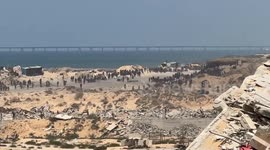
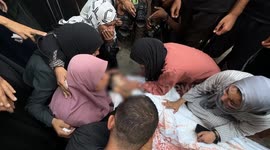
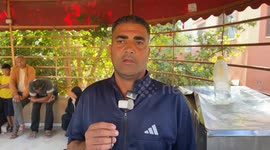
KHAN YOUNIS, GAZA STRIP, PALESTINE - DEC. 18: For over two years, Yousef Abu Hatab, 65, has performed a grim, relentless duty: burying the Palestinian dead in mass graves across the Gaza Strip. Since Oct. 15, 2023, the gravedigger estimates he has laid to rest between 17,000 and 18,000 people, a staggering testament to the scale of death caused by Israeli military operations.
In an interview with Anadolu at the Turkish Cemetery in Khan Younis on Thursday, Abu Hatab described a burial system pushed to collapse, where he works 14 to 16 hours daily, transferring bodies directly from shrouding areas to mass graves due to a lack of space.
"This is the most difficult period I have ever experienced in burial work, in labor, in hardship, and in exhaustion. I have never seen fatigue like this before," he said.
The veteran gravedigger, who is also the washer and shroud handler for the dead, detailed scenes of horror: underground rooms sealed with 15 bodies, collective graves near Nasser Hospital in Khan Younis holding hundreds, and days where he buried up to 100 people.
His personal tragedy intertwines with the collective catastrophe. Abu Hatab lost his son and his brother in Israeli attacks but continued his work. "Amid massacres, amid rubble, amid mass graves, amid horrific scenes… I am still continuing this work up to this moment," he stated.
The emotional and physical toll is profound. He recounted being tasked with placing a bag of unidentified, decomposed remains—hands, legs, heads—into a grave. "I swear, I could not stay inside that grave for more than one minute… I told them, 'Come and smell it. Smell this odor. Smell the stench — something you will never forget.'"
Abu Hatab also highlighted a critical lack of basic supplies. "I don’t have soap to wash the dead. I don’t have anything. For Allah’s sake, bring soap… I don’t have water," he pleaded, describing a near-total collapse of burial services.
While a ceasefire agreement took effect on Oct. 10, 2025, following Israeli attacks that began on Oct. 8, 2023, reports indicate ongoing occupation and violations. According to Gaza’s Health Ministry, Israeli violations since the ceasefire have resulted in 226 Palestinian deaths and 600 injuries.
The cumulative toll since October 2023 stands at a minimum of 68,865 Palestinians killed and 170,670 wounded, with women and children constituting the majority. The United Nations reports that 90% of Gaza’s infrastructure has been destroyed, with reconstruction costs estimated at around $70 billion.
Writing by Sibel Uygun
Categories
From the blog
Stories not Stock: 3 Reasons Why You Should Use UGC Instead of Stock Video
Video content is an essential part of a brand’s marketing strategy, and while stock footage has been a reliable go-to in the past, forward-thinking companies are looking to user-generated content for their video needs.
View post