A Bundle is already in your cart
You can only have one active bundle against your account at one time.
If you wish to purchase a different bundle please remove the current bundle from your cart.
You have unused credits
You still have credits against a bundle for a different licence. Once all of your credits have been used you can purchase a newly licenced bundle.
If you wish to purchase a different bundle please use your existing credits or contact our support team.
02:28

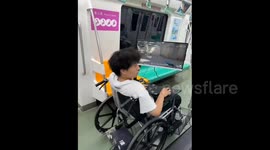
China: Brain-computer interface trial lets paralyzed man control wheelchair and robotic dog by thoughts

A recent clinical trial in Shanghai has enabled a paralyzed patient to control a wheelchair and even a robotic dog using only his thoughts, in what Chinese researchers call a breakthrough for brain-computer interface (BCI) technology. The trial was operated on a middle-aged man, who became quadriplegic after a spinal cord injury in 2022. He regained only limited head and neck movement despite more than a year of rehabilitation. In June 2025, Chinese researchers implanted him with a minimally invasive BCI system. After two to three weeks of training, he was able to control a computer cursor and tablet using his thoughts, matching the results of the team's first clinical trial. This time, researchers expanded the system from two-dimensional screen control to three-dimensional interaction with the physical world, enabling ultra-low-latency control of a power wheelchair and even a robotic dog. It might sound jarring, but Zhao said the surgery -- the second CAS-led invasive brain-computer interface clinical trial -- is minimally invasive. After the implant procedure, the patient is guided to use his thoughts. Speed is a critical aspect of the technology. By customizing communication protocols, the team reduced the end-to-end delay from neural signal acquisition to command execution by external devices to under 100 milliseconds, faster than the body's natural neural delay. This creates a seamless control experience. For now, invasive brain-computer interfaces are focused on medical use, with dozens of clinical cases already completed. China hopes to promote large-scale BCI applications for people with special needs in the foreseeable future. Shotlist: Shanghai, China - Recent: 1. Various of patient with high paraplegia operating wheelchair, controlling robotic dog via brain-computer interface (BCI) technology; 2. SOUNDBITE (Chinese) Zhao Zhengtuo, researcher, Center for Excellence in Brain Science and Intelligence Technology, Chinese Academy of Sciences: "The patient can use the robotic dog as an extension of his own body, as an intelligent agent, to go downstairs and pick up deliveries. He can also control a wheelchair with his thoughts and go outside for a walk. This has greatly enriched his daily life."; 3. Various of patient in wheelchair; 4. Various of brain-computer interface system on model; 5. SOUNDBITE (Chinese) Zhao Zhengtuo, researcher, Center for Excellence in Brain Science and Intelligence Technology, Chinese Academy of Sciences (partially overlaid with shot 6): "This is our brain-computer interface system. It consists of two parts. The front-end sensor is like an extremely thin wire, about one-hundredth the thickness of a human hair. A five-to-eight-millimeter section is implanted into the brain. The processor is embedded into the skull after thinning the bone by about three to five millimeters. Overall, it is a minimally invasive procedure." [SHOT OVERLAYING SOUNDBITE]; 6. Brain-computer interface system [SHOT OVERLAYING SOUNDBITE]; 7. Various of patient operating wheelchair; 8. SOUNDBITE (Chinese) Zhao Zhengtuo, researcher, Center for Excellence in Brain Science and Intelligence Technology, Chinese Academy of Sciences (partially overlaid with shots 9-10): "Although the patient cannot move his limbs, he can imagine movements, such as rotating his wrist. We map those intentions to external devices. It's like integrating the device into his body and experiencing it as part of himself." [SHOTS OVERLAYING SOUNDBITE]; 9. Screen showing image of robotic dog moving, brain data; 10. Robotic dog moving [SHOTS OVERLAYING SOUNDBITE]; 11. Various of researchers at work; 12. Brain-computer interface system; 13. Videos showing application of brain-computer interface system; 14. SOUNDBITE (Chinese) Pu Muming, scientific director, Center for Excellence in Brain Science and Intelligence Technology, Chinese Academy of Sciences (starting with shot 13/partially overlaid with shot 15): "In the future, there will be more applications, including decoding language and other intentions from the brain. We might find better ways to express internal brain information through external devices." [SHOT OVERLAYING SOUNDBITE]; 15. Various of brain-computer interface system [SHOT OVERLAYING SOUNDBITE]; 16. Various of patient playing video game through BCI technology, picking up delivery. [Restrictions: No access Chinese mainland]
Categories
From the blog
Stories not Stock: 3 Reasons Why You Should Use UGC Instead of Stock Video
Video content is an essential part of a brand’s marketing strategy, and while stock footage has been a reliable go-to in the past, forward-thinking companies are looking to user-generated content for their video needs.
View post