A Bundle is already in your cart
You can only have one active bundle against your account at one time.
If you wish to purchase a different bundle please remove the current bundle from your cart.
You have unused credits
You still have credits against a bundle for a different licence. Once all of your credits have been used you can purchase a newly licenced bundle.
If you wish to purchase a different bundle please use your existing credits or contact our support team.
02:07

China: Game-changing Industrial Embodied AI system put into action at Chinese chemical plant

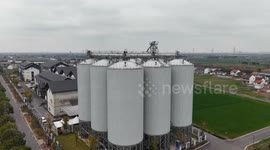
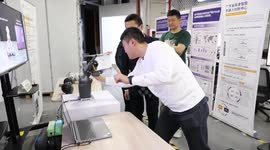
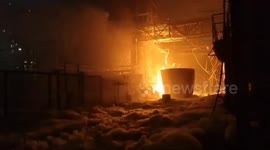
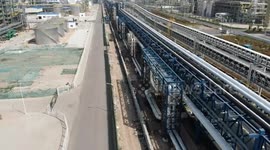
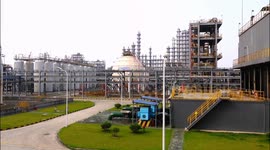
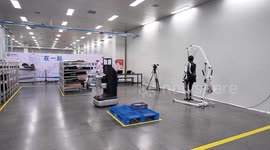
Storyline: China's artificial intelligence revolution has taken another big step forward after an innovative Industrial Embodied AI system recently went live at a chemical plant in Yichang City of central China's Hubei Province, a major breakthrough which developers say shows AI not only 'thinks' but now 'acts' as it plays its part in boosting productivity in the industrial automation field. Developed by the Supcon Technology firm and deployed at a facility owned by the Xingfa Group, one of China's leading chemical companies, the AI-powered technology is now fully integrated into the factory's physical systems and embedded directly into the plant's actual production process. On top of delivering essential perception, analysis, and decision-making, it is now entrusted with performing the physical execution of tasks, a development which could prove potentially game-changing for the industrial sector. At the plant's massive central control center, giant screens display a stream of data showing thousands of real-time operational parameters. However, unlike traditional control rooms which are often teeming full of engineers, this space is notably quieter and requires less manpower to keep things ticking over. That is all thanks to the new embodied AI system, which means human operators no longer need to constantly monitor or manually adjust equipment. Instead, the AI autonomously senses conditions, makes informed real-time decisions, and executes precise control actions across the entire production chain. Senior engineers say the adoption of this system has not only considerably cut costs but also greatly streamlined the workflow, while freeing up staff to concentrate on other essential tasks and giving a big boost to overall productivity. "The system effectively addresses long-standing issues such as frequent alarms, excessive manual intervention, and production instability. By adopting localized junction boxes, we've cut cabling and installation costs by 40 million yuan (over 5.6 million U.S. dollars), reduced overall construction expenses by 60 percent, and increased the number of data points each operator can oversee from 500 to 2,000. These have boosted operational efficiency by 67 percent and improved production efficiency by up to three percent. Employees have been freed from repetitive tasks and are transitioning into roles as AI trainers and anomaly response specialists, redefining human-machine collaboration and reshaping the very nature of productivity," said Li Yonggang, a chief engineer at the Xingfa Group. At the heart of this breakthrough are two proprietary technologies developed by the Hangzhou-based Supcon Technology, which has long specialized in the process automation industries field. Namely, these are the Time-series Pre-trained Transformer (TPT), an industrial-grade generative AI model trained on vast volumes of industrial data, and the Universal Control System (UCS), a software-defined architecture that replaces the traditional hardware-based Distributed Control Systems (DCS) which have been predominant in factory settings. The TPT enables equipment to perform expert-level reasoning and self-optimization, while the UCS eliminates the need for conventional control cabinets, slashing infrastructure complexity as well as costs. Together, they empower the AI system to deliver highly accurate early warning alarms for any emerging anomalies, enable predictive maintenance to be carried out, and consistently maintain key process indicators at industry-leading levels. The system itself could mark a watershed moment, according to Cui Shan, the chairman and CEO of Supcon Technology, who said it proves that AI has gone beyond merely thinking to now performing actions of its own. "It has endowed artificial intelligence with physical execution capabilities. AI not only 'thinks', but also 'acts'. By integrating perception, analysis, decision-making, and execution into a complete closed loop embedded directly into actual production processes, AI has become a fully autonomous, self-optimizing intelligent agent," said Cui. "The value of AI in industrial applications goes far beyond boosting production efficiency. More profoundly, it is redefining the boundaries of human-machine collaboration and management paradigms, while also enhancing the invisible competitive advantages of a company," he added. Designed specifically for process industries, the Industrial Embodied AI system is highly adaptable for use across multiple sectors such as chemicals, building materials, and energy. Its deployment signals a pivotal shift as industrial AI is no longer seen as just an auxiliary tool, but now a practical, problem-solving force that delivers measurable value on the factory floor. Shotlist: Yichang City, Hubei Province, central China - Recent: 1. Aerial shot of control center of Xingfa Group's chemical plant 2. Various of interior of control center, giant screens showing parameters; engineers working at computers 3. SOUNDBITE (Chinese) Li Yonggang, chief engineer, Xingfa Group (starting with shot 2/ending with shots 4-5): "The system effectively addresses long-standing issues such as frequent alarms, excessive manual intervention, and production instability. By adopting localized junction boxes, we've cut cabling and installation costs by 40 million yuan (over 5.6 million U.S. dollars), reduced overall construction expenses by 60 percent, and increased the number of data points each operator can oversee from 500 to 2,000. These have boosted operational efficiency by 67 percent and improved production efficiency by up to three percent. Employees have been freed from repetitive tasks and are transitioning into roles as AI trainers and anomaly response specialists, redefining human-machine collaboration and reshaping the very nature of productivity." 4. Various of giant screens showing TPT (Time-series Pre-trained Transformer) system, an industrial-grade generative AI model; production parameters 5. Animation depicting Industrial Embodied AI system 6. Various of Supcon Technology's Universal Control System (UCS), integrated into cabinet 7. Various of facilities at chemical plant, tanks, trucks 8. Various of production machine operating 9. Various of robot patrolling factory floor, monitoring machinery 10. SOUNDBITE (Chinese) Cui Shan, chairman and CEO, Supcon Technology (starting with shots 8-9/ending with shots 11-13): "It has endowed artificial intelligence with physical execution capabilities. AI not only 'thinks', but also 'acts'. By integrating perception, analysis, decision-making, and execution into a complete closed loop embedded directly into actual production processes, AI has become a fully autonomous, self-optimizing intelligent agent. The value of AI in industrial applications goes far beyond boosting production efficiency. More profoundly, it is redefining the boundaries of human-machine collaboration and management paradigms, while also enhancing the invisible competitive advantages of a company." 11. Various of Cui talking with employee of Xingfa Group 12. Various of screen showing TPT system, production parameters 13. Various of chemical plant, facilities. [Restrictions : No access Chinese mainland]
Categories
From the blog
Stories not Stock: 3 Reasons Why You Should Use UGC Instead of Stock Video
Video content is an essential part of a brand’s marketing strategy, and while stock footage has been a reliable go-to in the past, forward-thinking companies are looking to user-generated content for their video needs.
View post