A Bundle is already in your cart
You can only have one active bundle against your account at one time.
If you wish to purchase a different bundle please remove the current bundle from your cart.
You have unused credits
You still have credits against a bundle for a different licence. Once all of your credits have been used you can purchase a newly licenced bundle.
If you wish to purchase a different bundle please use your existing credits or contact our support team.
01:40

China: Smart technology brews top quality product in world's only "lighthouse factory" for soy sauce

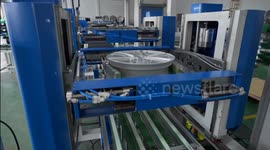
Storyline: Smart technology brews top quality product in world's only "lighthouse factory" for soy sauce [Voice_over] In south China's Foshan City, a 400-year-old soy sauce maker is using smart technology to revolutionize its production process, earning global recognition as the world's first "lighthouse factory" for soy sauce. The 200-hectare facility is part of the Haitian Flavouring and Food Company and was added to the global "lighthouse factory" network by the World Economic Forum in January this year. On the production floor of the world's largest soy sauce production base, AI and digital technologies are used across all stages of the manufacturing process. In one scenario, an AI-powered recognition system selects the best soybeans to turn into sauce. [Sound_bite] Li Wenzhe, Engineer, Haitian Flavouring and Food Company: "It leverages AI technology to capture 360-degree images without blind spots, identifying imperfections in each soybean. The system conducts a full inspection of more than 2.5 trillion beans annually." [Voice_over] Once selected, the beans are fermented then sun-dried. Powered by AI and big data technology, massive fermentation tanks are equipped with automatic oxygen, temperature, and humidity controls, and can even conduct a scheduled stirring. For quality control- an AI "nose" is used to determine a sauce's richness, a task previously relegated to a human inspector's sense of smell and taste. The factory also uses a digitized system for things like bottling and packaging. Thanks to this extensive automation, the factory produces a staggering four million tons of the condiment annually. [Restrictions: No access Chinese mainland]
Categories
From the blog
Stories not Stock: 3 Reasons Why You Should Use UGC Instead of Stock Video
Video content is an essential part of a brand’s marketing strategy, and while stock footage has been a reliable go-to in the past, forward-thinking companies are looking to user-generated content for their video needs.
View post