A Bundle is already in your cart
You can only have one active bundle against your account at one time.
If you wish to purchase a different bundle please remove the current bundle from your cart.
You have unused credits
You still have credits against a bundle for a different licence. Once all of your credits have been used you can purchase a newly licenced bundle.
If you wish to purchase a different bundle please use your existing credits or contact our support team.
Appears in Newsflare picks
04:42

Brain surgery patient plays clarinet during operation to stay awake

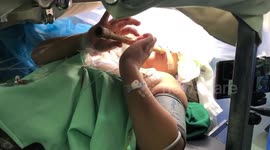
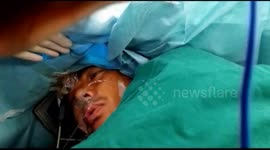
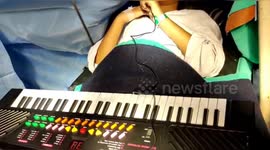
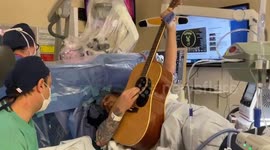
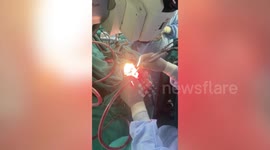
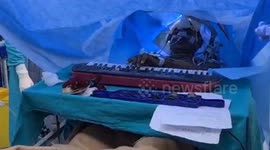
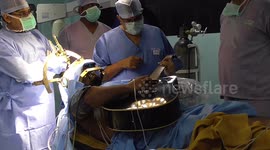
This is the incredible moment a brain surgery patient played the clarinet during her operation to stay awake.
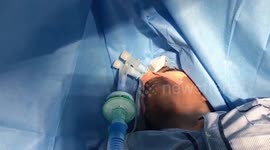
The Parkinson's disease patient played the instrument during a procedure known as Deep Brain Stimulation (DBS), allowing surgeons to witness immediate improvement in her movements after electrical stimulation was applied.
Denise Bacon, 65, a retired speech and language therapist from Crowborough, East Sussex, had struggled with stiffness and slowed movement since being diagnosed with Parkinson's in 2014.
Her symptoms made walking, swimming, dancing, and playing the clarinet increasingly difficult.
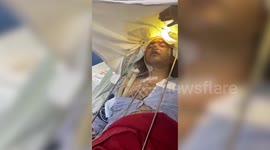
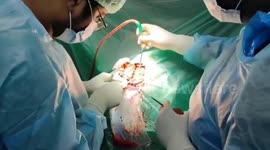
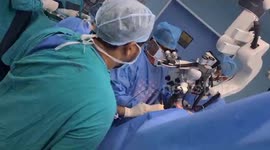
During a four-hour operation at King's College Hospital, Professor Keyoumars Ashkan MBE performed DBS, a surgical technique used for patients whose movement disorders do not respond to other treatments.
Electrodes were implanted in Denise's brain and connected to a pulse generator that delivers electrical impulses to regulate brain activity.
The effect was immediate. Once the current was applied, her finger movements improved, and she was able to play the clarinet with much greater ease.
Professor Ashkan explained that DBS, which involves placing stimulating electrodes deep within the brain, is a well-established procedure to improve motor symptoms in patients with movement disorders.
He said small holes were made in Denise's skull using a guiding frame ‘acting as a sat nav' to position the electrodes precisely.
As a passionate clarinet player, Denise brought her instrument into the operating room to test her ability during surgery. Surgeons observed an instant improvement once the stimulation was delivered to her brain.
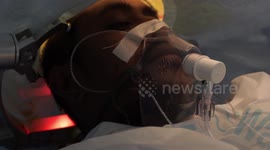
Awake under local anaesthetic, Denise recalled: 'I remember my right hand being able to move with much more ease once the stimulation was applied, and this in turn improved my ability to play the clarinet.'
She added that she is already noticing better walking ability and hopes to return to swimming and dancing soon.
Denise received a rechargeable generator implanted in her chest that can last up to 20 years and automatically adjusts stimulation based on brain activity.
Categories
From the blog
Stories not Stock: 3 Reasons Why You Should Use UGC Instead of Stock Video
Video content is an essential part of a brand’s marketing strategy, and while stock footage has been a reliable go-to in the past, forward-thinking companies are looking to user-generated content for their video needs.
View post